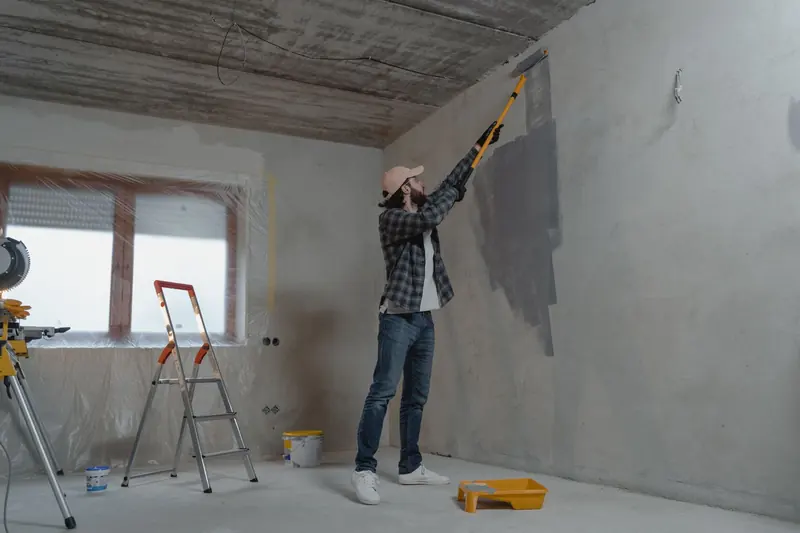
Which airless sprayer is right for wall putty and skim coat?
For wall putty and skim coat, contractors look at heavy-duty putty and texture sprayers such as the Graco Mark V HD and Mark X HD, not a standard paint sprayer. These machines are built to push thick, filled material through larger passages, so the pump, hose and gun do not choke or wear out quickly.
If you run a finishing crew in Ghaziabad, Noida or Gurgaon, you already know the real cost of putty work is not the putty. It is the number of masons and helpers standing on a scaffold for days, applying coat after coat by trowel. This guide explains how spray application changes that workflow, which Graco machines are used for it, why an ordinary paint sprayer is the wrong tool, and how to prepare material so the job runs smoothly. Everything here is general guidance. Always follow the putty maker’s data sheet and the Graco manual for your machine.
Why builders look at spraying for putty and skim coat
Hand application of putty is slow, tiring and dependent on skilled labour. On a large residential tower, a hospital block or a commercial shell, the wall area is huge and the schedule is tight. Spraying puts the material on the wall quickly, and the crew then levels it with a blade or trowel. The sprayer does the heavy loading; the skilled hand does the finishing.
- Faster coverage. A sprayer applies material to a wall much faster than a worker can load and spread by hand, so the same crew covers more area per shift.
- More even thickness. A steady spray pattern lays material down in a more uniform layer, which reduces the amount of levelling and sanding later.
- Less fatigue. Carrying and lifting buckets, loading hawks and repeating the same arm motion all day wears out a crew. A sprayer reduces that load.
- Better use of skilled people. Your best finishers spend time on levelling and corners instead of loading material.
We are not quoting any fixed saving, because it depends on the putty, the wall condition, the crew and the site. What contractors report is simple: fewer people on the wall, a shorter cycle between coats and a more predictable finish.
Why a standard paint sprayer is the wrong machine
This is the most common mistake we see. A contractor buys a general-purpose airless paint sprayer and tries to spray putty with it. It usually ends badly, for clear technical reasons.
- Material is far thicker. Paint is a thin liquid. Putty and skim coat are heavy, filled pastes that contain fine powders or fillers. A paint pump is designed for flowing liquid, not paste.
- Fillers are abrasive. Cement-based and mineral-filled putty wears pump parts, seats, hoses and tips much faster than paint does.
- Small passages block. Paint sprayers have fine filters and narrow fluid paths. Thick material clogs them, pressure becomes unstable and the machine stalls.
- Wrong tip and gun. The orifice used for fine paint atomisation is not suited to spreading heavy material.
- Warranty and wear problems. Running abrasive, thick material through a machine not built for it leads to early breakdowns. Warranty terms depend on the model and are confirmed when quoting, so always ask what use is covered.
A putty and texture sprayer is built differently. It is designed for heavy, filled material, with a pump and fluid path made for that duty. That is why the Graco Mark V HD and Mark X HD are the models people ask about for this work.
Graco machines used for putty and skim coat
VTech Solution is an authorised Graco distributor, and our Graco airless sprayers range includes machines made for heavy materials. For putty and skim work, the two names to know are these.
Graco Mark V HD
The Mark V HD is a putty, texture and paint sprayer. It is a heavy-duty machine meant for contractors who spray thick material regularly. It is a practical choice when a crew wants one dependable machine for putty and for other heavy coatings used on building sites.
Graco Mark X HD
The Mark X HD is in the same family of putty, texture and paint sprayers and includes Blue-Link technology. If you want a machine from the newer technology line, ask us about it when you call. We will explain how the two machines differ for your kind of work and confirm availability at that time.
| Point | Hand application | Standard paint sprayer | Mark V HD / Mark X HD |
|---|---|---|---|
| Suited to thick putty | Yes, slow | No | Yes, made for it |
| Crew size needed | Large | Not applicable | Smaller, with levelling crew |
| Handles filled, abrasive material | Yes | Wears quickly | Built for heavy duty |
| Consistency of layer | Depends on worker | Poor with putty | More uniform |
| Other uses | None | Thin paints | Putty, texture, paint |
We do not publish machine prices online. Prices are quoted on the call, depending on the model and what you need with it.
Material preparation before you spray
Most spraying problems begin at the mixing bucket, not at the gun. Whether you use a ready-mixed putty or a powder, preparation decides how well the machine runs.
- Read the data sheet. The putty maker states the water ratio, mixing time and working life. Follow it. Do not guess.
- Use clean water and clean containers. Old set material in a bucket will end up in your pump and block the tip.
- Mix to a smooth, lump-free consistency. Lumps are the number one cause of blockages. Mix with a paddle mixer, rest briefly if the data sheet says so, and remix.
- Strain if needed. If your material tends to have coarse particles, strain it before it goes into the hopper.
- Mix only what you can spray in the working time. Putty that starts to set in the hose is expensive to clear. In 45 degrees C summer heat, working time shortens, so mix smaller batches.
- Keep material cool and covered. In May and June on a Delhi NCR site, bags and buckets left in direct sun heat up and set faster.
Wall preparation matters just as much
Spraying does not hide a bad substrate. Before any putty goes on, the wall must be ready.
- Remove loose plaster, laitance, dust and any form-oil or release agent.
- Repair cracks and holes with a suitable repair material and let it cure.
- Check that the plaster has dried properly. Fresh plaster with high moisture causes putty to fail later. During the monsoon, walls stay damp for longer, so allow extra time.
- Dampen or prime absorbent surfaces only if the putty data sheet says so.
- Protect windows, floors, door frames and fittings. Spray reaches further than you expect.
In winter, Delhi NCR smog and dust settle on fresh putty. Cover openings and do not leave the sprayed surface exposed to blowing dust before it is levelled.
A practical spraying workflow
Every site is different, but this sequence works for most crews.
- Set up the machine on stable, level ground, close to the wall to keep the hose short. Check the manual for the correct start-up steps.
- Prime the pump and flush the lines per the manual before introducing putty.
- Do a test patch on a small area. Check the pattern, thickness and how the material behaves when levelled.
- Spray in controlled passes, keeping the gun at a steady distance and overlapping each pass.
- Level straight away with a blade or trowel, while the material is still workable. A second person following the sprayer keeps the work moving.
- Let the coat dry as per the data sheet, then sand and apply a second coat if needed.
- Clean the machine properly at the end of the shift, and at every long break. Putty that sets inside the pump is the most common cause of breakdowns.
Labour logic: where the saving really comes from
Think about the job in terms of labour days rather than machine features. A large wall area needs a certain number of worker-days for hand loading and spreading. A sprayer cuts the loading step sharply, so the same area needs fewer worker-days on the wall, and the finishing crew works on a continuous front. The saving also shows up as a shorter programme, which matters when a builder is working to a handover date and the painting contractor is waiting behind you.
Work out the numbers for your own site: wall area, current crew, current days per coat. Then ask what changes if loading is mechanised. We can talk through that logic with you on a call, but we will not invent figures for your job.
Maintenance habits that protect the machine
- Clean immediately after use; never leave putty overnight in the pump or hose.
- Inspect seals, hoses and the gun regularly, because abrasive material wears them faster than paint does.
- Keep spare wear parts on hand so a small failure does not stop the site. Ask us about spares for your model.
- Protect the machine from power problems. If your site has frequent cuts, plan for them, and never restart a pump full of setting putty without clearing it.
- Store the machine under cover, away from dust and rain.
Common mistakes to avoid
- Using a thin-paint sprayer for putty.
- Mixing too much material in one batch on a hot day.
- Skipping the test patch.
- Spraying onto damp or dusty walls.
- Letting the levelling crew fall behind the sprayer, so the material skins over.
- Forgetting to flush and clean at the end of the day.
What to tell us when you call
To recommend the right machine, we need a few details from you:
- The type of material: ready-mixed putty, powder putty, skim coat or textured finish, and the brand if known.
- Approximate wall area and how many floors or blocks.
- Your current crew size and how you apply material today.
- Site location and power situation, including whether you rely on a generator.
- Whether you also want to spray texture or paint with the same machine.
- Your timeline and how many coats you plan.
Our team will suggest a suitable Graco model, confirm availability and quote on the call. You can also see the wider range on our Graco airless sprayers page or browse all products.
Talk to VTech Solution
VTech Solution has served contractors, factories and builders from Sahibabad Industrial Area, Ghaziabad since 2011, and we supply across Delhi NCR including Noida, Loni, Faridabad and Manesar. We are open Monday to Saturday, 10am to 6pm. If you are planning a putty or skim coat job and want a straight answer on the right machine, call us on +91 98111 70042 or write to sales@vtechsolution.co.in, or use the contact page.
Frequently asked questions
Can I spray wall putty with a normal paint sprayer?
No. A standard paint sprayer is built for thin liquids and has fine filters and narrow passages. Thick, filled putty blocks them and wears the pump quickly. Putty and texture sprayers such as the Graco Mark V HD and Mark X HD are made for heavy material. Always check the putty data sheet.
Which Graco machines are used for putty and skim coat?
The Graco Mark V HD and Mark X HD are putty, texture and paint sprayers used for this work. The Mark X HD includes Blue-Link technology. Call VTech Solution on +91 98111 70042 and we will suggest the right model for your wall area and crew.
How much labour does a putty sprayer save?
It depends on the putty, wall condition and crew, so we do not quote a fixed figure. The sprayer takes over the loading and spreading, so fewer workers are needed on the wall and a smaller finishing crew levels the sprayed material. Compare worker-days on your own site.
Do I still need to level the putty after spraying?
Yes. Spraying lays the material on quickly and evenly, but a blade or trowel crew usually levels it while it is still workable. Plan one finisher close behind each spray operator, so the putty does not skin over, especially in 45 degrees C summer heat.
How do I get a price for a Graco putty sprayer?
Prices are not listed online. Call VTech Solution on +91 98111 70042 or email sales@vtechsolution.co.in with your material, wall area and crew size. We confirm the suitable model and availability and quote on the call. Warranty depends on the model and is confirmed when quoting.